Showing posts with label museums. Show all posts

Friday, May 22, 2026

The Portland Art Museum

selection of artwork at the Portland Art Museum

When I travel, I always try to make time to visit local art museums. I especially like to go to museums that are smaller, less well known, etc. I often discover real treasures, from excellent regional work, artists who should be better known and even works from very famous artists that never make the art books and travelling blockbuster museum shows. Santa Barbara, Long Beach, Tucson, Boise, just point me to the art museum.

I get up to Portland now and then but realized it has been 18 years since I visited the Portland Art Museum. The museum has tripled in size since my last visit.  This is an example where more exhibition space is better (that is not always the case).

It is always satisfying to see a lot of local artists featured in a museum. The Inkling Studio show is an excellent showcase of local printmaking.  Mark Rothko was a local artist, but most of the blockbuster work is elsewhere. As an artist, I found seeing some of his early work fascinating. There is a beach scene that reminded me of Chaïm Soutine.  The museum has Soutine’s The Little Pastry Cook — a pleasure to see as we do not have any of his work on display in the Bay Area. The photography of the Kenji Nakahashi was also well curated, it is shown with contemporary Japanese ceramics.

I must be sure not to wait 18 years to go back.

Wednesday, May 4, 2016

Looking Forward at the SFMOMA

The long wait is over and the new, expanded San Francisco Museum of Modern Art is back.  And, in keeping with the word of 2016, the museum is HUGE!  With the addition added to the existing building, the museum is about three times as big as it was before – making it one of the largest art museums in the country.  Yesterday I was able to get a preview visit before the grand opening on May 14th.
First, let’s talk architecture – last week the Guardian ran a hit piece that was hilarious and whiny in that way only the English can complain.  As amusing as it was, I suspect the reviewer might have only looked at the architectural renderings.  The new building is great – sure one could go through and nitpick with any new building, but overall it is really good.  The museum is spacious, natural light is allowed in and there are additional and welcome terraces where visitors can get some fresh air when they need to take a break.  Fortunately, the Tuesday afternoon preview was not crowded, but even on busy days, the space seems well prepared for crowds to flow through.
It’s the spaciousness that is the key.  A major shortcoming with the old museum was its lack of what I call “vista walls.”  Large, modern pieces need those rooms and galleries where visitors have a nice long approach to the big work.  The new museum has no shortage of clean, open rooms.  And, with plenty of space, many artists are given their own gallery.  There are few modern art museums that can dedicate so many rooms to individual artists. 
The SFMOMA retains its “top-down” plan where the logical approach is to ride the elevator to the top floor (7) and work one’s way down via the stairs.   The museum is so large now, that it has reached the size of “too big to see in one visit.”  Again, the terraces to pause for a rest are welcome along with the extra café areas.  I never see the need for multiple museum gift shops, but I do enjoy having a break and a coffee in the middle of a museum trip.

As you work your down the stairs you find a remodeled third floor focusing on photography.  It’s always been a strong point of the SFMOMA’s collection and the third floor could be a museum in itself.  The second floor becomes familiar as the galleries retain the feel of the older building and include the original collection.  And for all the new, the second speaks mostly to my personal taste — I like the second floor best of all.
As the museum has grown with the addition of the Fisher Collection and plenty of other newly acquired works, what is missing in the massive institution becomes painfully obvious.  There is that persistent, disappointing under-representation of California artists.   Sadly, the SFMOMA remains reluctant to showcase what all Californians should be proud of – our art.   This is why I steer out-of-town visitors towards the Oakland Museum or on to the Crocker in Sacramento and the di Rosa Preserve up in Napa.  While the collection of German modern art is excellent at the SFMOMA, if you have come all the way from Hamburg or Berlin, is that the art you want to see in California?
And of course, unsurprisingly, works by women and artists of color still can be a challenge to find.  One could make a sad scavenger hunt seeking out diversity.  This is a job for the Guerilla Girls! 

The new SFMOMA is a forward-looking building and a great start, but it now needs to grow into the 21st Century and represent a broader cross-section of modern art and artists.

Saturday, September 20, 2014

A Museum Day in Santa Fe

I like to get to New Mexico at least once every year.  Unfortunately I had not been back for a few years.  But that situation was remedied by a visit earlier this month to the state I like to call The Holy Land.  It never disappoints and it was great catching up with friends, eating a lot of good food and seeing some awesome art. 
In spite of the touristy, over-turquoised side of Santa Fe, I always enjoy the place and the collection of art museums there are world class.  I started with the Georgia O’Keeffe Museum where I learned something new – I had no idea she visited Hawaii and did some incredible work.  I began my day with those green lush landscapes and already knew it was worth the trip.   
The next stop was the New Mexico Museum of Art.  There’s a fine permanent collection and my personal “discovery” of the artist/printmaker Gustave Baumann. Delilah Montoya’s show Syncretism included an installation of photos depicting the desert landscape migrants cross to reach the United States with empty plastic water bottles dangling from the photos (see above).  A compelling installation but I am curious why the curator failed to label the work in Spanish as well as English.  It seems odd that in a place like the New Mexico Museum of Art the labels are not bilingual.  
The Museum of Contemporary Native Arts retrospective of Ric Gendron’s paintings was another show that asked me why we don’t get things like this in San Francisco?  Not that I regret travelling to Santa Fe, but one wonders about some of the curatorial choices made in the “big” city I call home.   One of the docents very correctly recommended I watch the video of the Bert Benally and Ai Weiwei installation. 
Lunch was up the hill and then visits to the Museum of Indian Arts & Culture and a perennial favorite – the Museum of International Folk Art. 
You might be wondering why I haven’t mentioned any galleries?  Well, in 20 years of visiting Santa Fe, I still have not made it Canyon Road – maybe next time, well, probably not.  And I also missed SITE Santa Fe – just because the New York Times gushes, doesn’t mean we have to go.  Plus, it was also closed the day I was there.  When I got up the next morning, I left town instead of seeing SITE Santa Fe.  I headed south for the sublime experience of remote abandoned missions instead.  Plus there is plenty of contemporary “art” for me to see in San Francisco if I choose to. 

My museum day was a full day and a perfect day – finished off with green chili mac-n-cheese washed down with cold beer.

Sunday, July 13, 2014

Inspired at Stanford

Europe and America 19th Century Gallery, Cantor Arts Center

I always check out the smaller city, less nationally known, art museums when I am on my road trips.  This past week I finally made a long overdue, and first visit, to a museum that’s quite close by.  Stanford University and the Cantor Arts Center is less than an hour away.  I knew the museum was known for its collection of Rodin sculpture (only the Musée Rodin in Paris has a larger collection) but I knew little more about what I would find.  I was surprised at how large and thorough the museum was. Aside from the Rodins, there are not other specific focuses to the collection.  Rather, the museum offers a solid collection of gallery after gallery of different periods and genres.  It doesn’t cover it all, but what it covers, it covers quite well.  And there are some real gems that make the museum worth a visit (a Georgia O’Keefe, David Park and Elmer Bischoff are all worth seeking out).

From a more personal nature, I left the place quite inspired.  I always have liked old-fashioned, salon style displays of walls of art.  And the galleries at the Cantor Arts Center offered some good examples.  This made me think about my current series of Collagescapes.  The most recent ones have been placed in repurposed and antique picture frames (see below).  I envision more and more framed in this way.  I am inspired to fill my own wall salon style with a new series of framed pieces. 


Friday, July 11, 2014

Six Millennium of Butter and other things at the Legion of Honor

Mound of Butter, Antoine Vollon

This week it was time to venture out to the Legion of Honor.  It was a nice, quiet afternoon and even the ever-so-hyped-up special show was busy but not unbearably crowded.  That show, Intimate Impressionism from the National Gallery of Art, is a nice, thorough collection of Impressionist treasures from the Smithsonian. I recognized some from prior visits to Washington (see above).  I do love butter, and with Antoine Vollon’s Mound of Butter, what’s not to love? 

I attended the exhibit with a friend who is a member, so we did not need to pay admission.  Another friend pointed out a real issue with this show – as usual, the museum is demanding an extra charge to see a special exhibit.  Museums seem to do this now on a regular basis with their “blockbuster” shows.   They sometimes charge extra even when they show art they own – art from their own collections.  Well in this case, the Legion of Honor is charging the public extra to see art that we own.  The collection of the National Gallery of Art belongs to you, me and every other American.  Admission is free at the Smithsonian because the contents belong to the American people.  Taxpayer dollars and private fundraising keep it that way.  I’ve noticed the price of butter has gone up at every supermarket, but what is happening out in Lincoln Park is simply wrong.

Butter remains a theme at the Legion of Honor (keep reading).  As is often the case, there is a less promoted yet wonderful show hidden upstairs – Masters of Fire: The Copper Age in the Holy Land.  These ancient treasures are aesthetically pleasing and historically interesting, but what I kept telling myself is that they are all about 6,000 years old.  6,000 years old!  Copper, ceramics, carved stone but even scraps of textiles and a pair of sandals. The age and preservation is astounding and mostly because of an inaccessible cave in an extremely dry part of the world.  And yes, butter.  Well not 6,000 years old butter, but ceramic, Chalcolothic butter churns (you can see a few examples here).

Many of the pieces in Master of Fire look strikingly modern.  Some of the zoomorphic ossuaries reminded me of anime characters, much of the copper and stone work could be placed in a display of contemporary art and fool many viewers.  But for me, the star of the show was this little stone carved ram (see below).  Like a direct ancestor of Henry Moore, it’s artistic perfection achieved thousands of years ago.

The Masters of Fire is the first of its kind show in the United States and will be at the Legion of Honor until January 5, 2015 (and you can see it for the regular admission price without an extra fee).

Monday, May 5, 2014

Exit through the cyber gift shop…


As I drink coffee at out of my Gilbert & George mug that rests on my Van Gogh coaster, I muse, where is the Tofu merchandise?  When will you see me and exit through the gift shop?  Oh but wait, you can.   I have a bunch of my work available through Society 6. 

And this week, until May 11, if you follow this link, you get free shipping on most merchandise to anywhere in the world.

Friday, April 4, 2014

A Glowing Review

Starlight Night, Lake George, 1922.

Today’s visit to the de Young museum reinforced my belief that you always have to see art in person whenever you can.  The big exhibit right now is Modern Nature: Georgia O’Keeffe and Lake George.  They could give the show an alternate name like You think you know Georgia?  This is not the Georgia O’Keeffe that most people are familiar with.  It was years ago when I first discovered there was more to O’Keeffe than her well known work from New Mexico.  Her earlier work from upstate New York and Canada is often overlooked.  The Lake George work becomes quickly recognizable yet the subjects are not as often associated with her.  There are verdant Adirondack landscapes and still mountain lakes, leaves, apples, and “exotic” alligator pears (avocados).  The exhibit has pulled in pieces from private collections and many smaller museums.  Paintings rarely that are brought together for a show.  The Licking Cow from the Denver Art Museum is worth the price of admission.

What was most exciting is seeing paintings in person that, while nice, just don’t look as good online or in any art book.  And even though the show’s catalog is well done – we have not achieved a printing technology that does Georgia O’Keeffe’s work justice.  As a painter, seeing her explore the same themes but with a varying palette was, yes I’ll say it, inspirational.  Color, color and more color and in many directions.  So many of the paintings glow.  They are like beacons that pull you across the room.

Time is running out, you have until May 11th to catch these gems in person.  And now, I have start a petition to rename New York’s Lake George.  It’s named for the English monarch George II.  It’s time we changed the name to Lake Georgia.

Friday, July 19, 2013

Diebenkorn at the de Young


Berkeley #22, Richard Diebenkorn

In recent years I have had little interest in the hyped-up, blockbuster shows at the de Young.  But finally they’ve hit a home run right out of the park.   Richard Diebenkorn – The Berkeley Years, 1953-1966 does everything a major museum show is supposed to do.  There are pieces familiar to de Young regulars and a few from other Bay Area Museums.  Bulking up the large show are plenty of rarely seen works from private collections as well as pieces from museums, big and small, around the country.  The de Young should be praised for the effort it took to bring in so many single pieces from different museums.  The show fills the museum’s entire lower level special exhibition space and overflows to the main floor as well.  I believe this might be the largest amount of space the de Young has ever devoted to a single artist – and deservedly so for a Bay Area giant like Diebenkorn. 

The show is one that demands more than one look – it’s up until September 29, 2013.  And, as Scarlet Johansson never played Richard Diebenkorn in a movie, the crowds are manageable.  You can take in those big pieces from across the room without a mob in the way entranced by their audio tour.

Tuesday, May 7, 2013

What is a Major Museum?

I just saw my third excellent museum show this spring.  In March, I was down at the San Jose Museum of Art for the Eric Fischl show.  My most recent trip across the Bay took me to the Oakland Museum where I was overwhelmed by Hung Liu’s retrospective show Summoning Ghosts: The Art of Hung Liu.  And on Saturday, I was down in Pasadena at the Pasadena Museum of California Art for California Scene Paintings from 1930 to 1960. 

I went into the Hung Liu show blind, knowing virtually nothing about the artist or her work.  This might be the best way to approach an artist that one is unfamiliar with.  When you “discover” and love the work, it makes it all the more exciting.  The exhibit site has background details and examples of her work.  More can be seen on Liu’s website.  The biggest surprise about the exhibit was that this outstanding, local artist was still unknown to me.  And while the San Francisco museums have all picked up her work for their collections, they certainly haven’t featured it and given Hung Liu the attention she deserves.  This might be a job for the Guerilla Girls. 

As “old fashioned” as it might be too some, I love representational, pre-abstract, pre-WWII, American painting – Edward Hopper, Thomas Hart Benton, Grant Wood et al.    If all three of them had headed west and settled in California, they would probably be part of the current show of California Scene Paintings in Pasadena.  It is full of work by artists I need to become more familiar with, names like Phil Dike and Emil Kosa, Jr. along with another California favorite – Millard Sheets. What’s particularly special about this show is that most the works are borrowed from private collections. They rarely get seen by the general public. 

The exhibit is more focused on Los Angeles and Southern California.  Many of the paintings have preserved rural scenes lost to suburban sprawl long ago.  There are also paintings of lost neighborhoods like Los Angeles’s Bunker Hill and Chavez Ravine — communities that were completely destroyed in the name of urban renewal and building freeways.  After seeing the show, driving down the Pasadena Freeway and coming to the interchange where The 5 and 110 meet, I was trying not to get too distracted imagining the hilltop neighborhood of Victorian homes that used to be in the same spot.

Seeing all three of these shows, reminds me of why I go to museums.  It’s all about exposing myself to work that influences me, often on a subconscious level, as well as my ongoing art education.  But I also can’t help noticing that I am seeing the best work in what many might dub small, or “second” or even “third tier” museums.  Few would call any of these three “major museums.”  But I have to begin to ask, just what makes a “major” museum?  Is it the hyped up blockbuster shows with high admission prices?  Is it sticking the Girl with a Pearl Earring’s mug on everything from a mug to shopping bag to a tie? We might need to revisit what really defines a “major” art museum.  Shouldn’t it be about the art instead of the hype?

Tuesday, March 12, 2013

Eric Fischl: The Best Show of 2012

I know it when I see it.  Every year I see, what for me, will be the best show of the year. Dive Deep: Eric Fischl and the Process of Painting at the San Jose Museum of Art takes the prize.  It is only March, and I might get to see something better in 2012, but I am pretty certain we have a winner.

I first discovered Eric Fischl about 10 years ago, saw a few paintings and now have his work in a few art books.  Since that time, I have been wanting and waiting to see a retrospective of his work.  I rarely get down to the San Jose Museum of Art, and, when I do, I am never disappointed.  Today I was, well, amazed.  I was expecting nothing more than an opportunity to see a few rooms full of big, bold paintings in person.  Work I only knew from the printed page.

Certainly I could have read more about the show beforehand.  The website has an excellent description and a video interview I recommend.  Yes, I recognize that I am suggesting you read up on the show, when I didn’t.  Over the years I have developed a serious case of hype-fatigue when it comes to museum shows.  So many museums go from blockbuster to blockbuster, hyping each show up like the latest action movie out of Hollywood.  I tend to tune out the press and just go see the art.

The folks in San Jose haven’t, by any means, hyped the show.  Sure, it’s been promoted, but with this exhibit, the energy is put into curation.  The show really lives up to the title, yes, you can just view the work on its own, but what is offered is true insight into the artist’s process.  There are plenty of big paintings.  But there are also studies, prints, watercolors, maquettes and photography that all lead up to those bigger paintings.  If you were new to Fischl’s work and only saw some of the small watercolors or the maquettes he starts with, you’d be impressed with those as finished work.  But this exhibit gives you a much, no pun intended, bigger picture.  There is also a short piece of film included where Eric Fischl discusses his process.  When I feel compelled to watch a film as part of an exhibit (something I never do), well, that alone says how much I think of the show.  The only thing missing, and I really have no complaints, but I would have liked to see an even bigger show and more of those massive Fischl paintings.

You have until May 12th to see the best show of 2012.  So head down to San Jose soon.

Thursday, December 6, 2012

Brand Name Art


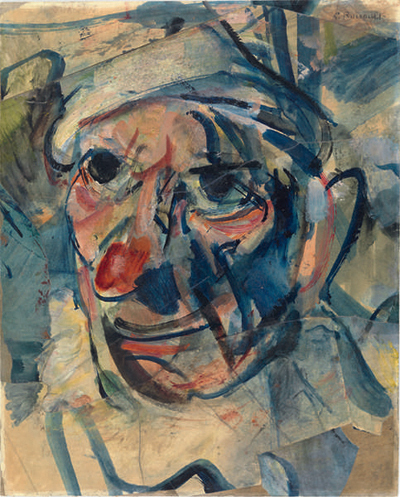
The Clown, Georges Rouault

I’ve become rather dispirited by the trend of blockbusterism in museum exhibits.  Desperate to draw the public away from their iDevices, museums hype up shows like the latest summer movie.  They focus in on certain artists who could be described as the A-Listers of art history.  Museums stock the gift shop with mugs and trinkets and wait for the throngs to come.  And, well, they do.  These are the shows that are impossibly crowded.  Even on a rainy Wednesday, you don’t stand a chance of looking at anything that is on the audio tour.  Isolated behind headphones the sheep stop where they are told and then stand and gape.  I encounter this at the major museums in San Francisco, but it is not an isolated problem, it’s a global curse of big city museums — all the more reason to stop by museums in places like Reno.

I had to keep an open mind as I approached the de Young for the latest big show.  The William S. Paley Collection: A Taste of Modernism.   I braced myself for crowds and hype, but I couldn’t let an opportunity go by to see some Gaugins and Cezannes when they come to San Francisco.  Along with you Gaugins and Cezannes, you have your Matisses and Picassos. All the names sure to bring in the once-or-twice-a-year crowd who need to see some art.  Art they “know” is good. 

Every work by a great master is not necessarily a masterpiece.  Okay, there is not a bad painting in the exhibit.  But let’s be honest, they are not all great either.  Truthfully, much of Mr. Paley’s collection is full of second-tier work by big name artists.  This is the type of collection that is amassed by the wealthy when they are more-focused on names rather than art.  When that happens, no matter how rich the collector, they are usually a generation or two behind.  They rarely can acquire the best work from a famous artist.  But there is treasure to see in the show.  Much of what I call “second tier” is quite strong, smaller paintings that would have been overlooked by earlier collectors.  In particular there is a nice wall of little Édouard Vuillards.  The strongest work in the show might be the work by the expressionist Georges Rouault (including the work shown above).  Ironically, it’s the collections first tier work by a second tier artist like Rouault that really shines. 

I have to mention the last work in the exhibit.  Seemingly out of place, just before the gift shop, was an Edward Hopper watercolor of Charleston, South Carolina (a place not particularly associated with Hopper).  It’s another work that makes the show, hype aside, worth seeing before it closes at the end of this month.

Tuesday, June 19, 2012

The GLBT Museum: A Model for an Ideal San Francisco History Museum?


Last year San Francisco’s GLBT Historical Society found a home in the Castro when the GLBT History Museum opened up on 18th Street.   This week I finally made a visit.  In recent years the Castro has evolved from being a gay tourist destination to being a tourist destination.  The neighborhood has really needed something beyond rainbow themed souvenirs.  Not that you have to be a tourist to take away something from the museum.  The museum does a great job and that could be the end of the story, but it really made me think about other museum possibilities.

I have always loved history and some of that love goes back to a childhood in Buffalo.  Buffalo has the Historical Society.  It’s a grand museum with room after room of exhibits and (if it’s still there) a recreation of olde time streets on the lower level.  As a kid, it was one of my favorite museums.  I have always wondered why San Francisco doesn’t have such a museum.  We have the history for it and we even have a place.  The Old Mint on 5th and Market is slated to become that museum.  But unless we find an über-wealthy history nerd as a backer, it’s still years away.  We do have the California Historical Society on Mission Street.  It’s small, but their exhibits are always worth checking out, in particular their current show on the Golden Gate Bridge.  Across the Bay the Oakland Museum’s History Department was good, and now, since the renovation, it’s fantastic.  Currently it’s the closest thing we have to a grand history museum in the Bay Area,

My visit to the GLBT Museum got me thinking.  I still want to see that BIG museum happen in the Old Mint, but at the same time we need something more.  The GLBT Museum’s space is in a renovated, large storefront.  Why couldn’t we have museums like that in different neighborhoods?  A sort of branch library model for a history museum spread across the City.  The Mission, Chinatown, Jackson Square, Japantown, and the Haight are just some of the neighborhoods that would have locations.  All the individual museums would be modest in size.  They would be ideal for a small dose of museum time.  Or, one could make a day of it, adventuring to different museum spots all over San Francisco.

As much as I love the big museum concept, perhaps the best way to experience San Francisco’s history is to have to explore the City and it’s different neighborhoods at the same time.